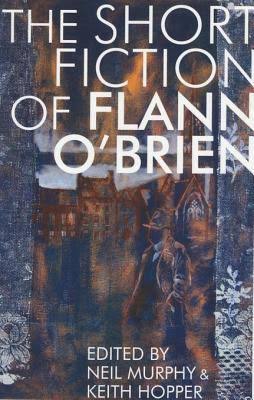
There is a dichotomy that exists between Flann O’Brien’s works on dystopian literature particularly his short story “Revenge on the English in the year 2032!” and authors John Kelly and Kevin Barry’s respective novels From Out of the City and City of Bohane.
These texts operating as speculative dystopia narratives on the state of Ireland have a combined publication date of eighty two years however with O’Brien’s published in 1932, whilst Barry’s and Kelly’s published in 2011 and 2014 respectively. How this helps analytically lies in the continuum of dystopian literature that the texts produce when combined. When they are analysed together this continuum reveals how the Irish psyche has subconsciously projected the creation of a shared dystopian moment in the imagined tomorrow. This flashpoint spans the third to fifth decade of the twenty first century. Using this fixed point in time these writers project a vision of the future. A vision traditionally founded upon one single moment of disaster. These dystopias are constructed to reflect and hypothetically calculate the possible future of the nation during the moment of the texts composition. The Colonial nightmare of the British Empire found in Flann O’Brien’s text is replaced in Kelly’s book by the might of American capitalist culture. Barry’s dystopian landscape meanwhile is founded upon the calamity of austerity. Published following the economic collapse of two thousand and eight, the government introduced substantial cuts and raised numerous taxes, resulting in what has become commonly known as austerity economics. What Barry’s text helps to speculate upon is the future of Ireland under these policies where the states presence has completely diminished.
Through the unifying focus on this flashpoint era these authors have built a parallax through which we can gaze at the levels of entropy possible within an imagined field. Helping us to realise how the Irish dystopian model has altered since the dystopian vision depicted by Flann O’Brien. These dystopias portray markers that vibrate in unison through each text giving us a framework for what constitutes the Irish dystopia genre. In order to determine the paradigm shifts that occur in these differing future portraits three fixed aspects of what comprises the dystopian genre will be analysed. These three abstract concepts that affect the creation and variations in dystopian narratives are the provision of a pre narrative cataclysmic event, a totalitarian organised society and language. By studying how these three areas can affect the narrative we can understand how the dystopia flashpoint can alter its structure in order to reflect the societal differentiation’s of caused by the passing of real-time.
One core marker of the genre is the collapse of traditional social order into a totalitarian governance structure caused by a prior cataclysmic event. In the case of O’Brien’s text the massacre of Halloween 1997 is the root of the action similar to how the opening events of Kelly’s deals with the direct aftermath of the assassination of the most powerful man of 2040. Barry’s text meanwhile actually inverts the cataclysmic moment from an impinging event on the narrative pretext to a slow retreat of civilisation through neglect. There is no recollection among the citizens of Bohane as to how current order came into existence as the pre-narrative event takes less precedence to the slow regression of society back towards unlawfulness.
The second marker within these texts that align them to the dystopian genre is the use of totalitarian force enacting to suppress individual autonomy. What separates the Irish dystopia from that of its global counterpart is how this suppression is imposed by the totalitarian force. For in each of the three texts memory acts to control the populace. This style of control is similar to subliminal messaging from the ruling establishment as elaborated upon by Aldous Huxley who believed subliminal messaging was a method of suppressing the individual’s autonomy. These texts will help to illustrate how memory can act to encourage national divisions, cause panic and fear but also create inaction. All helping to stabilise and reinforce the dystopian environment within the texts:
The scientific dictator of tomorrow will set up his whispering machines and subliminal projectors in schools and hospitals (children and sick are highly suggestable), and in all public places where audiences can be given a preliminary softening up by suggestibility-increasing oratory or rituals.
Following on from establishment of these two primary markers the third marker, language, will be discussed. This third marker relies on an understanding of the eighteenth century Italian philosopher Giambattista Vico, particularly his interpretation of language in New Science. Vico’s text argues that human nature is not an absolute but in fact a conditioned process informed and potentially altered by social institutions. Vico outlines how these social institutions use language to alter the human condition towards a civilised democracy or monarchy society through a three stage process. These three stages include: the Age of Gods, the Age of Heroes and the Age of Men. The Age of Gods relies on the people believing “that they were living under divine government, and that all their actions were commanded by auspices and oracles…”. The Age of Heroes focuses on the era when “heroes ruled everywhere in aristocratic states by virtue of their presumed natural superiority to the plebeians”. While the Age of Men occurs, “when all recognized their equality in human nature, so they first established democracies and later monarchies”. Each stage would lead into the next until the current interpretation of nationhood under monarchy or democracy emerged.
The relationship this critical work has to our understanding of dystopian literature relies on how dystopias adhere to the theoretical view of the construction of nations. Essentially instead of a monarchy being the ultimate achievement of Vico’s ‘Ages’ it is a dystopian environment ruled through totalitarianism. What Vico’s work will help us to understand is how, much like memory, language engages in reinforcing the natural order of the dystopia. Similar to how the Big Nothing, which most of the citizens of Bohane believe is the cause of their ills, language acts to reinforce the established norms of the dystopia society.
Beginning with O’Brien’s short story we are introduced in first person narration to the unnamed protagonist who arrives off a boat into a Gaelic speaking Ireland in the year twenty thirty two. The protagonist meets a young English student who asks for guidance, while originally agreeing our protagonist remembers the massacre of Irishmen years prior and is soon preying on the ignorance of the young man resulting in the student’s arrest. The cataclysmic event he refers to occurs on Halloween nineteen ninety seven, where “2,000 respectable Corkmen” are slaughtered in Dublin. This event surfaces in our protagonist’s memory during his discussion with the English student who acts as a literary manifestation of the reality of the post nineteen sixteen era. Physical brutal conflict is central to all potential past and futures and this tragic outlook is reflected in the text’s structure as the past contains violence and so too does its conclusion.
The prior cataclysmic event of Halloween Night is central to the creation of the dystopian genre, but O’Brien’s story is deceiving because “despite the dystopian vision…, the Ireland of the future is described as having considerable material wealth…” (Jack Fennell). We are led to believe that it is purely the actions of the individual protagonist which determine the actions of the text. It is he who causes the arrest of the English student through his manipulations, but the true cause of the man’s actions are a socially constructed memory. The Protagonist anger towards the English student stems from the social memory of the events of 1997, an event that occurred within the fictionalised past of this 2032 narrative. Though that physical conflict is no longer apparent as an English student is able to travel to Ireland freely tension between the two nations are still high within the narrative. As O’Brien slyly deals with shadow war that is fought monetarily through socio-political economics acting as a foreshadowing for the conflict at the end of the text.
Our unnamed protagonist arrives from a ship into the harbour, where upon his bags being checked he must pay tax on his hat “You have to pay five shillings on this hat,” he said, pulling a new hat out of the depths of my bag”. The fact that the new hat was buried in the bag and the quietness of its owner upon realising he will have to pay reveals the monetary structure of the Ireland of the future. Tax on a new hat may seem myopic in the context of the larger future narrative at hand yet in this action we realise that what O’Brien is presenting to the reader is the continuation of the national tension between Ireland and England. In 1932, the same year as this story’s publication, protectionist policies admired by Dáil Éireann opposition leader’s Fianna Fáil were becoming increasingly popular against English goods. These policies would come into effect by the years end. That hat is English and the protagonist will have to pay to have it. How can we guess that this apparel is English? Well we know he has just arrived by boat and right behind him as he queues to exist the customs area and board the train is an Englishman. The tax on the English hat is merely a hint at the depressing image that exists in this imagined tomorrow, the trade war continues and so too does the divide between the nations.
Physical conflict is the real focal point of this dystopian future, while the issue of import tax is the more subtle monetary skirmish between nations. Written in an age of armed violence, the prologue and the ending of this story are charged with the brutality of war. As Jack Fennell informs us in his article “Brian O’Nolan’s Science Fiction” the “reader is not told what led to the 1997 massacre”. The format of the narrative gives us clues however as to the likelihood of this event’s real historical origin so that the reader can, “navigate this estranged world with regard to their cognitive abilities, interpreting the events of the narrative with reference to the established norms of our physical universe”.
Using this method as devised by Fennell for navigating the text we can reason that the massacre is in fact an amalgamation of the conflict of the War of Independence, from the burning of Cork to Bloody Sunday. One could even wager that the tragedy is in fact a future mapping of Bloody Sunday, by the sheer number of Cork men up from the country. A logical reasoning for this is that a GAA match had occurred that day, a symbol of the Gaelic cultural revival that seems to pervade the text. All of these deductions between the subtle taxes and the prevalent massacre build up to an illustration of how the physical history between Ireland and England has led to this dystopian environment, where violence begets violence.
O’Brien however presents to the reader not one but two moments of calamity that has led to this depiction of a future Ireland, that of Halloween night, but also the actions of Diarmaid Mac Murchadha. It was he whom the protagonist pins as the justification for his trickery, an act to balance out the trickery caused by this historical figure. This second or primal cataclysm found in the text actually reaffirms the divisions of society by national divides: individual identity is forgone, only nations remain. Those whose names are remembered as betrayers, the memory of them a punishment of the collective social memory to never be forgotten. Memory thus acts as the totalitarian force that encourages the conflict within this dystopia. It is the memories of the past which help to create the nationalist divisions and the established identity codes that “advocated a conventional relationship to cultural identification by subordinating the autonomy of citizens…” (O’Mahony and Delanty). Kevin Barry by comparison will attempt to combat this dynamic in his own text, City of Bohane by breaking the lineage of memory and altering the focus away from nationalist identity towards communal identity. In the context of O’Brien’s text the beating and tricking of the English student at the end of the text further reaffirms that as long as memory last in this future there will be no end to the conflict between Ireland and England:
“if Diarmaid Mac Murchadha played a dreadful trick on the Gaels, the Gaels have never been slow to give a little beating to Diarmaid’s friends, if God grants them the opportunity!”.
The divisions between what constitutes two men arriving into Ireland boil down to the subliminal actions of memory. What we also see is the unquestionable nature of our protagonist as he trusts completely in the state’s authority. While he may try to hide his hat from customs this is a sign of monetary greed rather than a defiance of the national agenda. His silence reveals his willing subjection to authority and we see no objections over the payment. Fennell states how the English translation actually loses some of the satirical aspects of the text due to the reliance on the English Students mispronunciations of Gaelic, but it also reduces the connection of language and state.
O’Brien’s choice to write the text in Gaelic actually compounds the dystopia totalitarian marker, the satire merely becoming the distraction. By originally framing the text within the Gaelic language, O’Brien is showing the connected nature of the state to language and is eliciting the control the state had over language. Even the Free State government of the nineteen twenties was involved in attempts to control the Gaelic language as Fennell writes that: “In a very real sense, the Dáil Éireann (or principal chamber of the Irish parliament) was attempting to create a language by committee” (Fennell). This text was not only originally published in Gaelic but also in The Irish Press, the Fianna Fáil Party’s newspaper. As oppositional figures at the time of the publication they do not represent the state power, however they do reflect the anti-British sentiment found in the text. At the time, Fianna Fáil was canvassing for protectionist economic policies and did not respect the Anglo Irish Treaty of nineteen twenty one. Writing on the role of language in dystopian literature David W. Sisk links this connection between language and state in his seminal work Transformation of Language in the Modern Dystopia:
The looking glass of twentieth-century dystopian fiction in English offers a rich body of literature in which concerns of social control through forcibly narrowed language play acritical role.
The future conjured before us can be seen as a culmination of these styles of polices and the disaster it can bring where free thought is blinded by state propaganda. The English student’s unfamiliarity with the Gaelic language creates an inferiority within his character. He becomes the manifestation of the other, the outsider to the totalitarian force of nationalism and must be removed. What this symbol of English language and state further reveals is the manifestation of Vico’s belief that “gestures and physical objects” bear a “natural relationship to the ideas they want to signify”, producing a relationship where language acts as symbol for a much deeper ideological system. The only piece of information that the protagonist learns about the student is his nationality and profession. Yet this is enough for the protagonist to become enraged because he clearly associates language to national identity.
O’Brien’s protagonist believes in his gods by the narratives end, the Irish state and its history due to language. Language division acts as an enforcer or encoder of national ideology in this landscape. We see this through the protagonist’s amnesia upon his arrival from the boat, “Where in the world am I? I wondered. Am I in Ireland or in Aran or in the deepest recesses of the devil’s Hell?”. While the Catholic symbolism of the priest satirically removes the chance that the man is in Hell, the same satire actually masks the narrator’s bewilderment. Yet when he meets and exchanges dialog with the English student we witness the man display an increasingly refined knowledge of both history and anger directed at the student. While his anger increases so do the vile attributes of the Gaelic language come to bear as the narrator teaches the student, “a stream of talk so full of malevolence, of ancient, awful, filthy and sour maledictions…that could make a corpse walk again”. What we are seeing in O’Brien’s text is a nasty twisting of Douglas Hyde’s 1892 text “The Necessity for De-Anglicising Ireland”.
Hyde, as a language activist and scholar, played an important role in the formation of the Gaelic League in 1893 causing a resurgence of the Gaelic language and art. His belief that England’s influence caused Ireland’s art produce to become “only distinguishable for their hideousness” reflects the relationship the protagonist has to the English student. Hyde believed that the Irish had damaged their identity by attempting to mimic their colonial rulers believing that the Irish should rely on their own history to produce art. We see this nationalistic attitude to language and culture in O’Brien’s protagonist as the more he talks to the Englishman the greater his aggression due to the culture represented by the student. Showing us that as long as language is tied to national identity and state, humanity will eventually fall to violence due to the encoding of memory.
 Man In The Attic
One thought on “Ireland in the Parallax and Paralysis of Time: How John Kelly and Kevin Barry’s future Dystopias conform and break from Flann O’Brien’s Imagined Tomorrow. Part 1”