Continued from Part 2
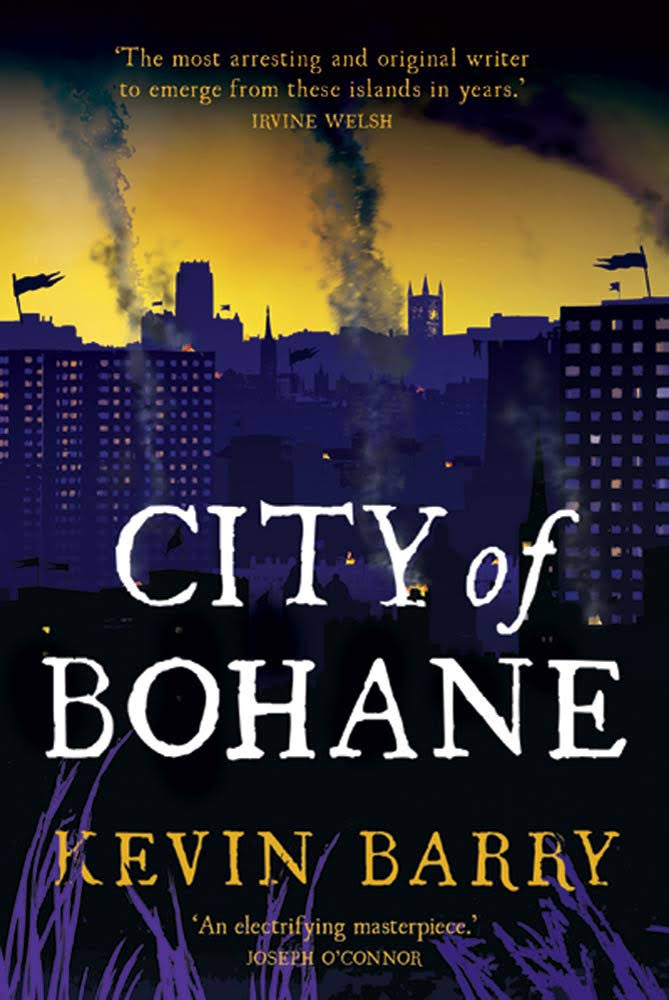
City of Bohane choses to focus on the midpoint of the twenty first century where society, unlike Kelly’s narrative, has become isolated from the rest of the nation and the outer world. Gang culture rules the city and the presence of bureaucracy and government seems minimalistic.
The premise of the text deals with the return Gant Broderick to Bohane and the oncoming gangland war between Logan Hartnett and the Eye’s Cusack. Barry’s text skews from the troupe of the cataclysmic event to establish his dystopian landscape of Bohane City. No singular vision as to why the world of 2053 has collapsed exists, yet the El train still operates through the city, and the butcher still opens, so complete degradation has not occurred either. The gap between the life of the early twenty first century and that of its reported middle are referred to as the ‘Lost-Time’ by men such as Gant Broderick former ruler of the ‘Fancy’, until Logan Hartnett removed him. Barry’s text thus alludes to the fact that the cataclysmic event itself may have been the faltering memory of the Bohane people, who can still remember the traditional customs of their lives but not the numerical order of things.
The contrast between the inherited knowledge of the August Fair which is treated as a grand standing tradition of the natives of Bohane compared to the knowledge of how their city fell into ruin leads one to conclude that there was no sudden cataclysm. Unlike O’Brien which pins the current depiction of 2032 as a result of a singular moment in time or Kelly who studies the individual as these moments occur; Barry deals with the possibilities that perhaps it simply doesn’t matter. The idea that this could be a potential future is plausible, but Barry focuses less on social critique and instead works his narrative to depict a world that is simply in the process of getting on.
This does not dismiss that Barry offers potential reasoning for the collapse of the once great city of Bohane, they just operate as subtext and are not critical to the workings of the narrative. The texts opening lays out reasoning for what has occurred pointing towards the Bohane River. This river sits as the origin point of the town, but the narrator believes it is the sinister nature of the river which has lead its citizens to their current dystopian environment.
The role of nature in Barry’s text garners it mystical interpretations such as the belief that that the river is evil as it is seen as the reason behind the collapsing city. Another reason given for the ruin of the city is the ‘untamped’ bog plain which could also have led to what the residents of Bohane refer to as its ‘taint’. The usage of land as potentially possessing the capabilities to alter the human condition is not uncommon but these references carry weight when sat in context the era of the texts publication the post boom years. The financial collapse caused by the ruthless exploitation of land and money reverberates through the Barry’s text. The reason none in Bohane can remember as to why their world collapsed is because they did nothing to cause it. Much like the common individual following the financial crisis, the zeitgeist of blame spread like the malevolence off the Bohane River until it seemed none were without fault through the forces of austerity. One of the most telling scenes of the text occurs during a meeting of the authority, who wish to discuss the feud that has just occurred between Hartnett and the Cusack’s.
These figures are given temporal positioning we are told that the date and time is “22 December, 12.01 a.m.” in the chapter title. The relevance this has to the discussion over the aspects of concepts of Irish dystopia pertains to the lack of accurate time anywhere else in the text. In fact the only other instance comes from the knuckles of a boy who has the years of birth and death of his father engraved into his hands. What both points have in commonality is that one exists due to a death the other an authority paid from taxes. While this may seem unorthodox the cliché that the only constants are death and taxes actually offers us a way of recording time, “The authority men truly cared that the once great and cosmopolitan city of Bohane should retain at least the semblance of its old civility”. Unlike Kelly who has every event recorded in his narrative, or O’Brien where memory is owned by a national consciousness, Barry’s Bohane is primarily concerned with the singular events, the recharging of the lives of folks. Gant’s disappearance into recollection with the rest at the Capricorn Bar signifies the position of the communal society over the greater national society, upending the depiction of nation found in O’Brien’s text.
In accordance with the Age of Men however the text offers us an example of the communal dystopia, a world not built on the high speed interchange of digital memory found in Kelly’s hypertext vision or the configuration of memory under nationalist influence. Instead Barry’s text incorporates Burgess styled language in which grammar and slang have taken hold. The text becomes a fable or folk tale that spreads outwards, unlike O’Brien’s singular authorial narrative voice or Kelly’s second hand in depth report:
“It’s a disguised first-person narrative. The narrator is in there to give the story the feeling of a yarn or a saga or a fable” (Barry, ANOBIUM).
Words such as Police are morphed into phonetic totems of isolation revealing the altered communal society’s acceptance of Vico’s Age of Men, “The Bohane accent sounded everywhere: flat and harsh along the constants, sing-song and soupy on the vowels, betimes vaguely Caribbean”. Even with the degradation of language however in this speculative black hole called Bohane off the Northwest of Imagined Ireland, everyone still understands each other and everyone knows each other, expressing the communal nature of the text.
Novelist Keith Ridgway writing in the Irish Times interprets Barry’s use of language quite differently, instead seeing Barry’s text as a weakened cartoonish display where, “a flattening out of character and a vivid realisation of a hyper-real, familiar but skewed context”. Ridgway goes on to critique Barry’s usage of ethnic identity groups based on trope identities, particularly the Sand-Piky’s who are: “described before we meet them in purely derogatory terms, and later – and very explicitly – as being descendants of what we would recognise as a caricature of Travellers, live up to the reputation laid on them”. What Ridgway is missing however is the that due to the loss of memory surrounding that ‘Lost Time’, which men such as the Gant describe as the narratives previous forty years, identities have degraded as much as language, yet still everyone understands one another’s speech. When compared to O’Brien’s protagonist and English student who barely understand each other and give way to nationalist violence or Kelly’s world, full of double speak, Barry’s text offers a world where the control of language lies in the hands of the people of Bohane:
“The third language was the human or civilized language which used vocabulary agreed on by popular convention, and of which the people are absolute lords” (Vico).


One thought on “Ireland in the Parallax and Paralysis of Time: How John Kelly and Kevin Barry’s future Dystopias conform and break from Flann O’Brien’s Imagined Tomorrow. Part 3”